

Prevent diesel-fuel gelling this winter

Cold-flow improvers keep the fuel flowing – and your truck rolling.

Shop the article

AMSOIL Diesel Fuel Additives
Brad Nelson
by Brad Nelson
February 16, 2026

Up here in the northern U.S., we’ve entered the frigid winter season. We have to throw on an extra layer of clothing to combat temperatures well below zero and clear ice from our ice-fishing holes a little more frequently.

For those operating diesel vehicles, it’s also important to be wary of the fuel you’re using.

Diesel fuel can gel in winter

Diesel fuel contains naturally occurring paraffins (wax) that solidify in cold temperatures. Normally the wax is in liquid form, and because it provides high cetane value, it delivers a valuable benefit. When temperatures drop, wax crystals form and cling to one another. As temperatures continue to decrease, wax-crystal formation continues until it restricts the flow of fuel through fuel lines and filters, eventually stalling the engine. Wax formation in fuel is commonly known as “gelling.” Depending on the fuel, gelling can occur at temperatures below 32ºF (0ºC). Higher biodiesel blends, such as B20, can begin gelling at even warmer temperatures.

Cold-weather terminology

In addition to “gelling,” a few other common terms describe diesel cold-weather performance:

  • Cloud point – The temperature at which wax crystals begin to form in diesel fuel. This is normally around 32ºF (0ºC), but can be as high as 40ºF (4ºC).
  • Cold-filter-plugging point (CFPP) – The point at which wax crystals in untreated diesel fuel clog the fuel filter.
  • Pour point – The lowest temperature at which diesel fuel maintains its ability to flow.

AMSOIL
SHOP BY VEHICLE TOOL

  • Find products for your vehicle: passenger cars and light trucks, motorcycles, ATV/UTVs, snowmobiles, marine, heavy duty and more.
  • Vintage vehicle lookup guide.
  • Filter lookup and cross-reference guides.
Check out the guides

Winter-blend diesel fuel

The ultra-low-sulfur diesel (ULSD) at every pump must meet certain CFPP characteristics to help protect drivers. Refineries typically achieve this by producing winter-blend diesel fuel.

Winter-blend diesel is simply the standard #2 diesel fuel available at fuel stations everywhere mixed with some percentage of #1 diesel fuel. Number 1 diesel contains less wax and offers cloud and pour points of typically -20ºF (-29ºC) or colder, making it preferable in colder weather and essential in the coldest regions of the country.

So, why not just use #1 diesel in winter and call it a day? Because it produces approximately 95% the energy output of #2 diesel, reducing fuel economy and horsepower. It’s also a lot more expensive to produce, and the refinery passes that additional cost to the consumer.


Winter weather is unpredictable

Winter-blend diesel fuel does a decent job preventing gelling, but it’s not foolproof. Standards for winter-blend diesel fuel can vary significantly across the country, with northern states offering stronger blends and southern states offering milder blends. Refiners typically base their blends on temperature projections that don’t leave room for sudden and violent temperature swings. Up here in Superior, Wis., we can easily go from 40ºF (4ºC) to below zero in hours. If a driver arrives in the area running fuel that isn’t blended for those temperatures, the fuel could gel and leave the driver stranded.

In those situations, having an emergency diesel fuel additive on hand can be a life saver. AMSOIL Diesel Recovery (DRC) quickly dissolves gelled fuel to allow the operator to continue driving with minimal downtime. Its solvents and dispersants effectively break the molecular bonds between wax crystals, dissolving the gel structure and returning the fuel to a liquid state. It thaws frozen fuel filters and reduces the need for an emergency filter change, saving inconvenient and expensive tows or trips to an auto-parts store.

Use cold-flow improvers

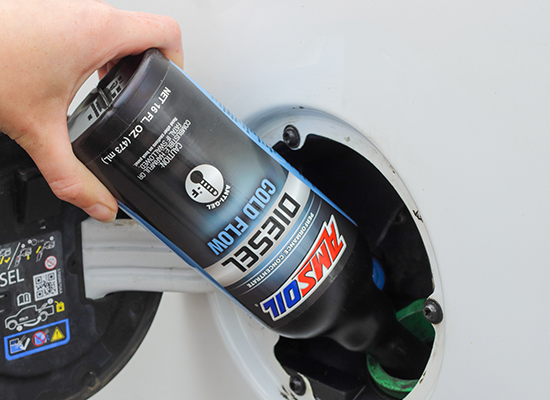
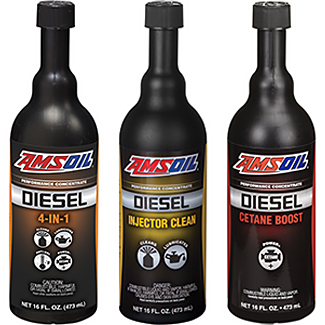
Rather than tempt fate, diesel operators are well-advised to use a diesel fuel additive, like AMSOIL Diesel Cold Flow or AMSOIL Diesel 4-IN-1, to prevent fuel gelling in the first place.

Diesel Cold Flow’s polymer-based additives are engineered to lower the fuel’s CFPP, significantly enhancing cold-temperature operability. The additives control phase change by converting any large wax crystals into many smaller crystals. AMSOIL Diesel Cold Flow absorbs onto these waxy crystal surfaces, reshaping them into needle-like or rounded shapes that don’t interlock like the large crystals. This prevents them from coming together to form blockages, keeping them suspended and allowing fuel to flow through fuel lines and filters. While it does not change the cloud point, it effectively controls wax-crystal size, shape and dispersion, reducing filter plugging and maintaining consistent fuel flow. In addition, Diesel Cold Flow functions as an advanced deicer, helping prevent fuel-filter icing by reducing ice formation in the presence of moisture (not to be confused with the function of Diesel Recovery).

For the best protection this winter, use AMSOIL Diesel Cold Flow or AMSOIL Diesel 4-IN-1 at every fill-up. It will keep your diesel starting and performing well throughout the winter, which will be one less thing to worry about on cold mornings.

by Brad Nelson

Brad Nelson is a staff writer for AMSOIL. Outside of work he enjoys family adventures, wilderness exploration and riding/wrenching on vintage metric motorcycles.

Shop the article

AMSOIL Diesel Fuel Additives

More like this